
Poker occupies a unique spot among casino games because it rewards observation, patience and a working knowledge of strategy rather than pure luck alone. For UK players browsing Gala Casino, the game offers a genuine alternative to reel-spinning or wheel-based titles, built instead around hand values, betting decisions and dealer rules.
This guide is written for players who want a clear, practical understanding of how casino poker actually works before they sit down at a table — whether that’s a live studio stream or a fast-paced online round. We’ll cover the rules, the variants on offer, and the kind of strategy that separates confident players from those simply guessing.
Throughout, we’ll point out where poker fits within the wider Gala Casino lineup, so you can see how it compares to other card and table options available on the site.
Poker Rules Explained
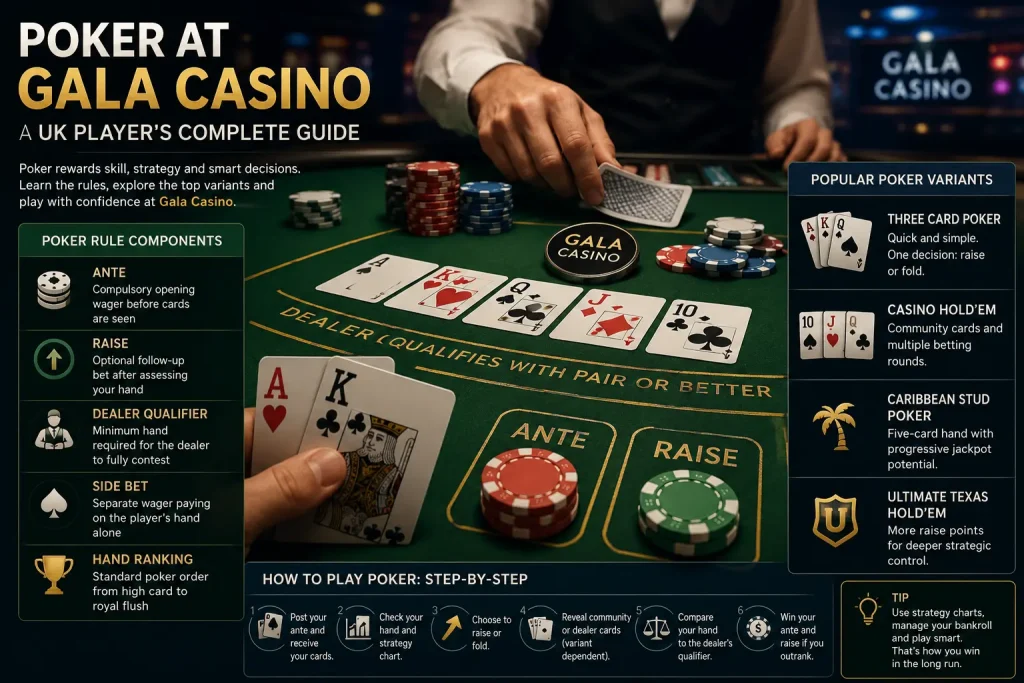
Casino poker games are built on standard poker hand rankings, running from high card through to royal flush, but the rules that actually shape a round are found in the betting structure rather than the hand values themselves. Most variants open with a mandatory ante, followed by a decision point where the player chooses whether to raise based on their hand.
Dealer qualification is a defining rule across several variants. The dealer typically needs a minimum hand — often a pair or better — for the raise bet to be contested at full value. When the dealer fails to qualify, the ante usually still pays, though the raise bet may resolve at reduced odds or simply push, depending on the exact paytable of the game in question.
Side bets operate under their own separate rules entirely, paying out based on the strength of the player’s hand alone, regardless of what the dealer holds. These wagers often carry the biggest potential payouts in the game, particularly for hands like straight flushes, but they also come with a steeper house edge than the main bet.
| Component | Function |
|---|---|
| Ante | Compulsory opening wager before cards are seen |
| Raise | Optional follow-up bet after assessing your hand |
| Dealer Qualifier | Minimum hand required for the dealer to fully contest |
| Side Bet | Separate wager paying on the player’s hand alone |
| Hand Ranking | Standard poker order from high card to royal flush |
What Is Poker?
At its core, poker is a card game centred on hand strength, betting rounds and reading the situation correctly. In the casino context, the format shifts slightly from traditional player-versus-player poker: you’re playing against the dealer, with fixed rules governing how each hand resolves rather than negotiating directly with opponents at the table.
This structure keeps the strategic depth intact while making the game more approachable for newcomers, since there’s a defined “correct” decision for most hands based on published strategy charts. It’s part of why poker continues to attract UK casino players who want more engagement than a purely chance-based game offers.
Poker sits comfortably within Gala Casino’s broader card and table game selection, and players who enjoy it often branch out into related titles once they’re comfortable with the fundamentals. The full casino games collection is worth a browse for anyone wanting to compare formats.
How to Play Poker: A Step-by-Step Walkthrough
While the finer details shift between variants, the overall flow of a casino poker round follows a consistent pattern. Here’s a general sequence that applies to most popular formats, including Casino Hold’em and Three Card Poker.
- Post your ante bet to begin the round and receive your starting cards.
- Examine your hand and compare it against the variant’s recommended strategy chart.
- Choose to raise if your hand meets the threshold, or fold to exit the round early.
- Allow any remaining community cards or dealer cards to be revealed, depending on the variant.
- Compare your final hand against the dealer’s qualifying hand once everything is shown.
- Collect payouts on your ante and raise if your hand outranks the dealer’s.
New players often benefit from running through several practice rounds before wagering real money, simply to build comfort with the pacing and the raise/fold decision point, which tends to be where most of the strategic weight sits.
Poker Variants You’ll Find at Gala Casino
Casino poker isn’t a single fixed game — it’s a family of related formats, each with its own betting rhythm and strategic demands. Picking the right one can make a noticeable difference to how enjoyable and manageable your sessions feel. Broadly, the most common variants break down like this:
- Three Card Poker — a quick, single-decision format ideal for newer players.
- Casino Hold’em — staged community card play with pre and post-flop raises.
- Caribbean Stud Poker — a single five-card hand with progressive jackpot potential.
- Ultimate Texas Hold’em — multiple raise points for players who want deeper strategic control.
Each of these is explored in more detail below, covering how the betting unfolds and what type of player tends to get the most out of it.
Three Card Poker
This variant deals just three cards to the player and three to the dealer, with no community cards or multi-stage betting to work through. The entire strategic decision comes down to one moment: is your three-card hand strong enough to raise, based on the standard strategy threshold used across most casinos.
Because the format is so streamlined, rounds move quickly, which suits players who prefer shorter sessions with less waiting between decisions. The optional Pair Plus side bet is a popular addition here, rewarding strong hands regardless of how they compare to the dealer’s cards, and it’s often the reason players return to this variant specifically.
Casino Hold’em
Built around the structure of Texas Hold’em, this variant deals two cards to the player and the dealer, followed by five shared community cards revealed across a flop, turn and river. Players get to decide whether to raise before or after the flop appears, which introduces a genuine strategic branch point that doesn’t exist in simpler variants.
The appeal of Casino Hold’em lies in how much a hand’s value can shift once community cards land. A modest starting hand can become considerably stronger — or reveal itself as clearly weak — once the flop is dealt, keeping the raise/fold decision dynamic throughout the round rather than fixed at the outset. Players who take the time to learn the recommended raise thresholds tend to get noticeably more value from this format over time.
Caribbean Stud Poker
Here, players are dealt five cards and must decide in a single moment whether to raise or fold against the dealer’s five-card hand, with no opportunity to swap or redraw any cards afterwards. That one-shot structure gives Caribbean Stud a distinct feel compared to multi-stage variants, since the entire round hinges on a single, carefully weighed decision.
Progressive jackpot side bets are closely associated with this variant, often triggered by hands like a straight flush or royal flush, and they’re a major draw for players hoping for a larger, less frequent payout. Understanding exactly how the dealer qualification rule works here is particularly important, since it directly determines how a non-qualifying dealer hand gets resolved.
Ultimate Texas Hold’em
A more advanced relative of Casino Hold’em, this variant allows raises at several points throughout the hand — before the flop, immediately after it, and again once the final community cards are revealed. That added flexibility means skilled players can size their wager based on how their hand develops at each stage, rather than committing everything upfront.
The trade-off is a steeper learning curve, since the correct raise size varies depending on exactly when in the hand you choose to act. Players willing to study the staged betting structure often find Ultimate Texas Hold’em one of the more rewarding variants available, precisely because it leaves more room for informed decision-making to shape the outcome.
Core Player Actions in Casino Poker
Regardless of which variant you choose, a handful of core actions form the backbone of every round. Knowing exactly what each one means — and when to use it — is what turns casual play into informed play.
| Action | Description | Result |
|---|---|---|
| Ante | Mandatory bet placed before cards are dealt | Grants access to your starting hand |
| Fold | Withdraw from the hand without raising | Forfeits the ante only |
| Raise | Add a wager once you’ve assessed your hand | Increases potential payout on a win |
| Call | Match an existing bet to remain active | Keeps you in the hand without escalating stakes |
| Side Bet | Optional wager based on your hand alone | Pays independently of the dealer’s result |
| Check | Pass without wagering, where the rules allow it | Advances the round at no extra cost |
The raise-or-fold decision is where most of the game’s skill element lives, particularly in variants with multiple betting stages. Players who commit to raising on borderline hands too often tend to see their bankroll erode faster than the game’s advertised house edge would suggest.
Betting Limits at Gala Casino
Ante limits vary depending on the specific poker variant and whether you’re seated at a live or online table. Entry-level tables often accept antes starting from around £1, keeping the game accessible for casual play, while higher-stake tables cater to players comfortable wagering more per hand. Raise limits are generally set as a multiple of the ante, so your maximum exposure scales in line with your opening bet.
It’s worth checking the posted limits before joining a table, since live dealer rooms and standard online tables don’t always mirror each other exactly. Players working with a fixed session budget should look for antes that comfortably fit within their planned spend for that sitting.
RTP and House Edge
Return to Player figures for casino poker variants generally fall in the 96%-99% range when optimal strategy is applied, though the exact number depends on the specific paytable used by each variant. Side bets tend to carry a noticeably lower RTP than the main ante/raise wager, reflecting the rarer hands required to trigger their bigger payouts.
House edge stays relatively favourable in poker compared to many other casino games, provided players stick closely to the correct raise/fold decisions outlined in strategy charts. Deviating from that — raising on hands strategy says to fold, for example — widens the house edge meaningfully over an extended session.
| Detail | Typical Value |
|---|---|
| Game Type | Casino-style poker, player vs dealer |
| RTP (Main Bet) | Roughly 96%-99% with correct strategy |
| House Edge | Depends on variant and strategy adherence |
| Side Bet RTP | Typically lower than the primary wager |
| Core Actions | Ante, raise, fold, call, side bet, check |
Live Dealer Poker
Live poker replicates the feel of an actual casino floor, with a real dealer managing the cards and pacing the round in real time. For players who miss the atmosphere of a physical table, this format delivers that experience through live streaming, chat functionality, and the natural rhythm of a human dealer rather than an automated shuffle.
Stream clarity and dealer professionalism tend to matter most here, since a smooth live experience depends on clear card visibility and responsive pacing. Peak hours can bring busier tables, so players hoping for a specific stake level may need to check availability before settling in.
Online Poker Format
The standard online version relies on a random number generator to determine card outcomes, which removes the dealer-paced waiting time found in live studios. This typically means faster rounds, making online poker a practical choice for players who want to get through more hands in a session or simply practise strategy decisions without delay.
Online tables also tend to offer a broader range of stake levels than live rooms, since there’s no physical dealer capacity limiting how many tables can run at once. That flexibility is particularly useful for players still building confidence with the raise/fold call.
Playing Poker on Mobile
Gala Casino’s poker games run directly through a mobile browser on both Android and iPhone devices, meaning there’s no separate app to download before you can start playing. On-screen controls are simplified for touch input, with clearly labelled buttons for ante, raise and fold decisions sized appropriately for smaller displays.
Demo mode is also accessible on mobile without needing to register an account, giving players a straightforward way to test a variant on their phone before deciding whether it’s worth playing with real funds. This is especially useful for checking how a multi-stage variant like Ultimate Texas Hold’em handles on a smaller screen.
Demo Mode vs Real Money Play
Demo mode uses virtual credits, letting players work through hand rankings, betting sequences and variant-specific rules with zero financial risk attached. It’s a genuinely useful tool for building familiarity with more complex formats, particularly those involving multiple raise points across a single hand.
Real money play introduces a psychological dimension that demo mode simply can’t replicate. Even players who feel entirely confident with the rules after extensive demo sessions often notice their decisions shift once actual funds are on the line. Easing into real stakes gradually, rather than jumping straight to higher limits, is a sensible way to manage that transition.
Beginner Strategy Guidance
Strategy in casino poker centres on knowing precisely which hands justify a raise and which are better off folded, based on the specific chart published for each variant. These charts exist because casino poker has mathematically defined optimal decisions, unlike traditional poker where reading opponents plays a bigger role.
A few general habits tend to serve newer players well across most variants:
- Study the specific strategy chart for your chosen variant before wagering real money.
- Hold off on side bets until you’re fully comfortable with the main betting rhythm.
- Resist raising on borderline hands just to stay active in a round.
- Play a solid number of demo hands to internalise the pacing of each variant.
- Review your raise-to-fold ratio periodically to spot patterns in your own decisions.
None of these habits guarantee a winning outcome — no approach to a casino game can — but they do reduce the kind of avoidable losses that come from inconsistent, impulsive decision-making at the table.
Managing Your Bankroll
Deciding on a session budget before you sit down is one of the most effective habits in casino poker, particularly because raise bets can multiply your exposure per hand more than flat-bet games typically allow for. It’s easy to underestimate how quickly stakes can climb once raises are factored in.
A practical approach is to split your total bankroll into a fixed number of betting units, so no single hand or session puts an outsized portion of your funds at risk. Setting clear win and loss limits in advance — and genuinely respecting them once a session starts — keeps poker feeling like entertainment rather than pressure.
Advantages and Disadvantages of Casino Poker
As with any casino game, poker comes with a mix of upsides and trade-offs that are worth weighing before committing significant time to it. The table below lays out the main points.
| Advantages | Disadvantages |
|---|---|
| Clear skill element through published strategy charts | Optimal play requires some memorisation to execute well |
| Several variants to match different play styles | Side bets often carry a noticeably lower RTP |
| Both live and online formats available | Live tables can see longer waits during peak hours |
| Free demo mode with no registration required | Faster online pace can increase spend if not tracked |
Similar Casino Games to Explore
Players drawn to poker’s mix of strategy and card-based decisions often gravitate towards blackjack next, where the hit/stand choice offers a comparable strategic layer against the dealer. Baccarat, meanwhile, provides a more relaxed pace for players who enjoy card-game atmosphere without as many active decisions to make.
For a broader look at what else is on offer alongside poker, the casino games section is the natural next stop, spanning other card tables, live dealer studios and beyond.
Responsible Gambling
The strategic depth of poker can make it easy to lose track of time, which is exactly why setting limits before you start matters. Gala Casino offers tools such as deposit limits, session reminders and self-exclusion options for players who want additional structure around their sessions.
If gambling ever starts to feel less like entertainment and more like something you can’t step away from, support is available in the UK through GamCare and the National Gambling Helpline. Reaching out early is always a stronger move than trying to manage the issue alone.
Frequently Asked Questions
Is poker at Gala Casino regulated and fair?
Yes, poker games available through Gala Casino operate under UK Gambling Commission oversight, meaning both random number generators and live dealer processes are independently tested for fairness before being offered to players.
Can I try poker without spending real money first?
Most online poker variants offer a demo mode using virtual credits, letting you learn the rules and betting rhythm without registering an account. Live dealer poker generally requires a real money account, since a human dealer is running the table.
What’s the smallest bet I can place on poker?
Minimum ante bets often start from around £1, though this depends on the specific variant and whether you’re playing a standard online table or a live dealer table, which can have slightly different limit structures.
Do I need a separate app to play poker on my phone?
No app is needed. Poker games load directly in your mobile browser on both Android and iPhone, with touch-optimised controls designed specifically for smaller screens.
Which poker variant should a beginner start with?
Three Card Poker is frequently recommended for newcomers thanks to its simplified single-decision structure and quick rounds, offering an easier introduction before moving on to multi-stage variants.
How does casino poker differ from traditional poker?
In casino poker, you play directly against the dealer rather than against other players, with fixed house rules governing qualification and payouts. Traditional poker is player versus player, with no fixed house hand to beat.
Should I always play the side bets available in poker variants?
Side bets can offer larger payouts for rare hands, but they typically carry a lower RTP than the main ante/raise wager. Many experienced players treat them as an occasional extra rather than a core part of their strategy.
What happens when the dealer’s hand doesn’t qualify?
In variants with a dealer qualification rule, a non-qualifying hand usually still pays out the ante, while the raise bet may push or pay at a reduced rate depending on that specific game’s paytable.